The Teen MBA
How to Make Money as a Teen
Quick answer: the easiest ways for a teen to make money are neighborhood services (babysitting, pet sitting, dog walking, yard work, tutoring), a part-time job once you're 14, or a small business that sells something people already buy, like baked goods or crafts. Pick one thing you're good at, set a price that covers your costs and your time, tell 10 people you know, and write down every dollar in and out.
What you can do at each age
In the US, the main federal rules for working teens come from the Fair Labor Standards Act (FLSA). The short version:
| Age | What the federal rules allow |
|---|---|
| Under 14 | Most regular jobs aren't allowed yet. But jobs like casual babysitting, helping neighbors with yard work, delivering newspapers and acting aren't covered by the rules, and you can work in a business your parents fully own. Running your own small business (a bake stand, a craft shop) is also fine with a parent's help. |
| 14–15 | You can work in places like shops, offices and restaurants, but only outside school hours: no more than 3 hours on a school day, 18 hours in a school week, and between 7 a.m. and 7 p.m. (9 p.m. from June 1 to Labor Day). Dangerous jobs are off limits. |
| 16–17 | No federal limit on hours, but jobs the Department of Labor calls hazardous are still off limits. |
States can add their own rules, and some require a work permit. Check your state's labor department website, or ask the employer.
20 ways to make money as a teen
Services for neighbors (good from about age 11)
- Babysitting. Take a first-aid or babysitting course to stand out and charge more.
- Pet sitting and dog walking. Regular weekday walks turn into steady weekly income.
- Yard work. Raking leaves, weeding, watering plants while people are away.
- Snow shoveling. Sell a "season pass" so you're paid even on light-snow weeks.
- Car washing. A bucket, sponges and a busy street.
- Tutoring younger kids. Reading, math or homework help after school.
- Tech help for older neighbors. Setting up phones, video calls and photo backups.
- Party helper. Setting up, serving and cleaning up at kids' birthday parties.
Things you can make or sell
- Baked goods. Cookies, brownies, bread. Check your local rules on selling food made at home.
- Crafts and jewelry. Bracelets, keychains, stickers, candles.
- Plants. Grow cuttings and sell them in pots.
- Reselling. Buy cheap at yard sales, clean it up, sell it for more (with a parent's help online).
- Custom T-shirts and tote bags. Take orders for teams, clubs and families.
Part-time jobs (from 14)
- Grocery store bagger or stocker.
- Restaurant host or busser.
- Camp counselor-in-training or summer camp helper.
- Lifeguard (from 15 with certification) or swim instructor helper.
Online skills (with a parent)
- Video editing or thumbnails for local creators and small businesses.
- Social media help for a family friend's shop.
- Selling digital designs such as planners or printables.
Most online marketplaces and payment apps require an adult account holder, so do online work through a parent's account and with their permission.
How to set your price (with real math)
Most teens price too low. A good price covers your costs, pays you for your time, and still looks fair to the customer. Here's how Lena, the character from The Teen MBA: Marketing, prices her Saturday bake stand:
Lena's cookie math
- One batch of 24 cookies costs $9.00 in ingredients, so $0.38 a cookie.
- A paper bag and a sticker add $0.10. Total cost per cookie: $0.48.
- She charges $1.50 a cookie, so she makes $1.02 on each one.
- On a good Saturday she sells 40 cookies: $60.00 in sales, $19.20 in costs, $40.80 profit.
- Baking and selling takes 4 hours, so she earns about $10.20 an hour.
If that hourly number feels too low, she can raise the price, sell more per hour (a "3 for $4" deal), or cut costs by buying flour in bulk.
For services, start from what you want to earn per hour, then check what other teens near you charge. If you're more reliable, better trained or bring your own equipment, you can charge more.
How to find your first customers
- Start with people who already trust you. Family, neighbors, family friends, your parents' coworkers. Ten personal messages beat 100 posters.
- Make a simple flyer with what you do, your price, your availability and a parent's phone number.
- Do a great first job, then ask for referrals. "If you know anyone else who needs a dog walker, I'd love an introduction." Word of mouth is the strongest marketing there is.
- Offer something regular. A weekly walk or a monthly lawn visit is worth far more than a one-off job.
- Find a gap. What do people near you complain about, or wish someone did? That's your best business idea. (This is Chapter 1 of the book, and it's free to read.)
Staying safe with money and strangers
- Always tell a parent where you're going, who the customer is, and when you'll be back.
- Work for people your family knows, or meet new customers with a parent first.
- Never share your home address, school or passwords online.
- Get paid on the spot, in cash or to a parent's app, and keep a record of every payment.
- If something feels wrong, leave. No job is worth it.
Do teens pay tax on what they earn?
Yes, there's no age exemption. If you have a job, your employer usually takes taxes out of your pay. If you work for yourself (babysitting, mowing, selling), the IRS says anyone, including minors, must file a tax return once their net earnings from self-employment reach $400 in a year. At that point you may also owe self-employment tax, which pays into Social Security and Medicare.
The easy habit: write down every dollar you earn and every dollar you spend on the business in a notebook or spreadsheet. Then ask a parent or a tax preparer to help at tax time. (This isn't tax advice for your situation.)
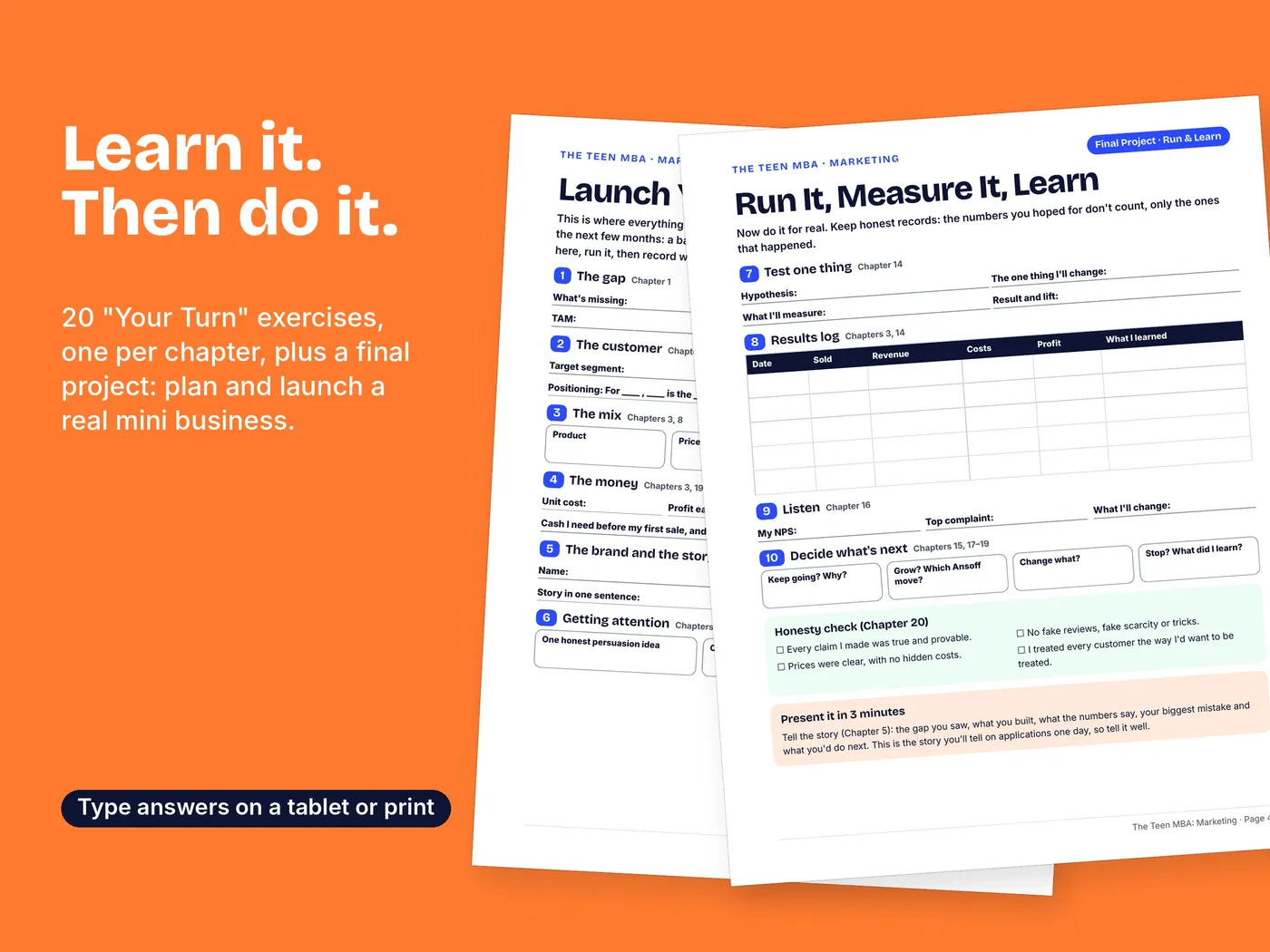
Your Turn: a 30-minute plan
- List 3 things you're good at and 3 things people near you need help with. Circle the overlap.
- Pick one idea and work out your cost per job and a price, like Lena did.
- Write a one-sentence pitch: "I'm [name], I [do what] for [who], for $[price]."
- Send it to 10 people you know (with a parent's OK) and count the replies.
Read Chapter 1 of The Teen MBA free
“Find a Gap”: how to spot a business idea people will actually pay for. Plain language, real math, an exercise to try.
Frequently asked questions
Can a 12 or 13-year-old get a job?
Not most regular jobs: the federal minimum age for most jobs is 14. But under-14s can babysit, help neighbors with yard work, deliver newspapers, act, work in a business their parents fully own, or run their own small business with a parent's help.
How many hours can a 14-year-old work?
Under federal rules, 14- and 15-year-olds can work up to 3 hours on a school day and 18 hours in a school week, between 7 a.m. and 7 p.m. (9 p.m. from June 1 to Labor Day). Some states have stricter rules.
What's the easiest way for a teen to make money fast?
Offer a service your neighbors already pay for, like dog walking, babysitting, yard work or snow shoveling, and message 10 people you know. You can start this weekend with almost no money.
Do teens have to pay taxes on babysitting or lawn mowing money?
If your net earnings from self-employment reach $400 in a year, the IRS says you must file a tax return, whatever your age, and you may owe self-employment tax. Keep a record of what you earn and spend, and ask a parent or tax preparer for help.
Can I make money online as a teen?
Yes, with a parent. Most marketplaces and payment apps require an adult account holder, so teens usually sell through a parent's account. Good options are video editing, social media help for local businesses, and digital designs.
Alkis Valentin is a serial entrepreneur who has worked across Asia, the Americas and Europe. He wrote The Teen MBA: Marketing for his daughter, to teach teens how real businesses find, win and keep customers.
- US Department of Labor: FLSA child labor rules for 14- and 15-year-olds
- US Department of Labor: Non-agricultural child labor standards (PDF)
- IRS: Young entrepreneurs and taxes
- IRS: A lesson for students starting a summer job
This guide is general information, not legal or tax advice. Rules vary by state and country.